Minimality in the
Stabilizer & Universal
Fragments of the ZX Calculus

Harry K. Stoltz

NYU
CQTS

This talk is based on...

Title page of Minimality of the stabilizer ZX calculus by Harry K. Stoltz

Minimality of the
Stabilizer ZX Calculus

Harry K. Stoltz

Title page of Minimality of the Pure Qubit ZX Calculus by Harry K. Stoltz and Renaud Vilmart

Minimality of the
Pure Qubit ZX Calculus

Harry K. Stoltz
and Renaud Vilmart

Upcoming

Master’s thesis

Harry K. Stoltz

An informal view…

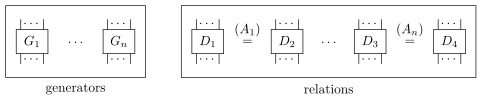
We view monoidal categories as a collection of generators \(\mathcal G\) and relations \(\mathcal R\):

early generators relations

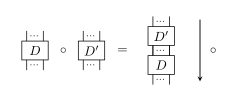
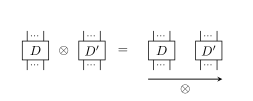
…where diagrams are built from the generators through two kinds of composition:

• Sequentially:

v3 composition sequential

• In parallel:

Parallel composition

Monoidal categories

Theorem. Every monoidal category \(\mathcal C\) admits
a presentation of generators \(\mathcal G\) and relations \(\mathcal R\):

\[\mathcal C=\langle\mathcal G\mid\mathcal R\rangle\]

Joyal–Street (1991), Selinger (2011, §3.1)

Interpretation

\[\llbracket-\rrbracket:\langle\mathcal G\mid\mathcal R\rangle\longrightarrow\mathcal C\]

Defined inductively by:

\[\llbracket D_2\circ D_1\rrbracket=\llbracket D_2\rrbracket\circ\llbracket D_1\rrbracket\]
\[\llbracket D_2\otimes D_1\rrbracket=\llbracket D_2\rrbracket\otimes\llbracket D_1\rrbracket\]
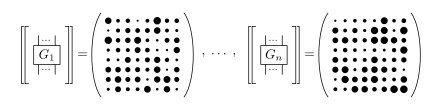
v7 early generator dot matrices

It is enough to assign the generators and check the relations.

Properties of Interest

• Soundness
(well-defined)
\(\forall D_1,D_2,\quad\mathcal R\vdash D_1=D_2\Rightarrow\llbracket D_1\rrbracket=\llbracket D_2\rrbracket\)

• Universality
(full)
\(\forall M\in\mathcal C(n,m),\quad\exists D:n\to m\ \text{s.t.}\ \llbracket D\rrbracket=M\)
• Completeness
(faithful)
\(\forall D_1,D_2,\quad\llbracket D_1\rrbracket=\llbracket D_2\rrbracket\Rightarrow\mathcal R\vdash D_1=D_2\)
• Minimality
(axiom independence)
\(\forall R\in\mathcal R,\quad\mathcal R\setminus\{R\}\nvdash R\)

Why minimality?

Captures the “essence” of an axiom.

• If it’s derivable:

Find a derivation!

• If it’s necessary:

Find an alternate interpretation!

For example…

• Complementarity
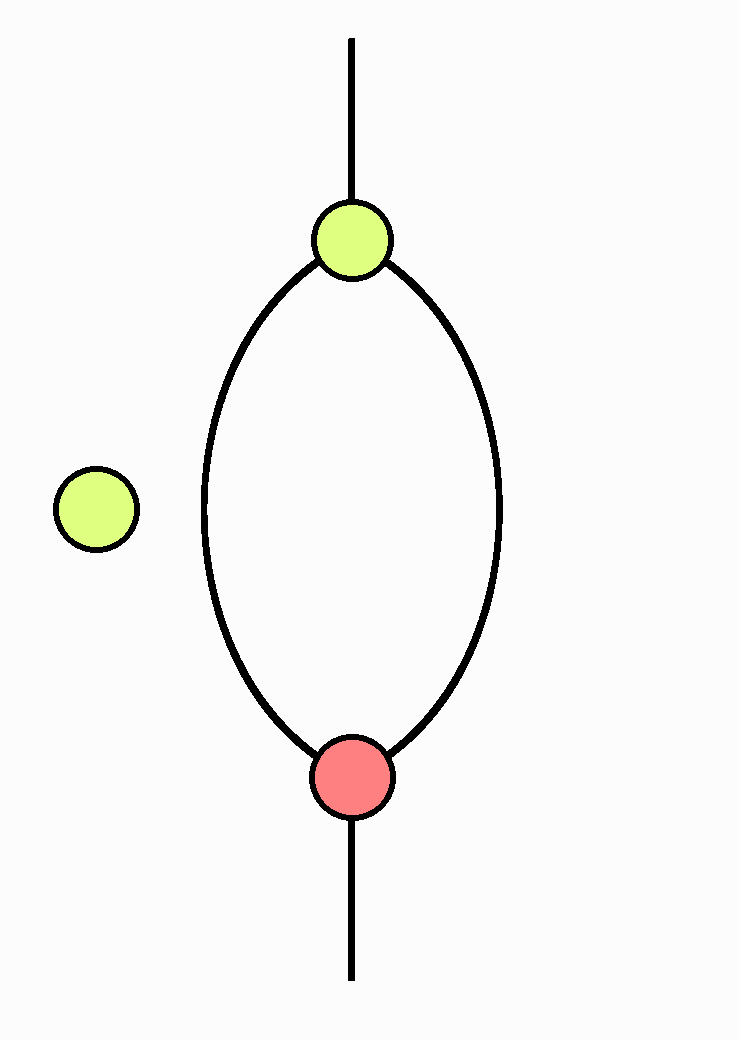
Complementarity: the initial diagram Complementarity: the derived diagram

• Strong complementarity

v4 qubit bialgebra law

Stabilizer Fragment

2009–2011
Soundness & Universality— Coecke & Duncan

“Interacting quantum observables: categorical algebra and diagrammatics”

2013–2014
Completeness— Backens

“The ZX-calculus is complete for stabilizer quantum mechanics”

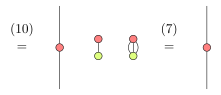
• 10 displayed rules

2015
Completeness— Backens

“Making the stabilizer ZX-calculus complete for scalars”

• 12 rules

2016–2017
Simplification— Backens, Perdrix, Wang

“A Simplified Stabilizer ZX-calculus”

• 9 rules!

2017–2020
Near-minimality— Backens, Perdrix, Wang

“Towards a Minimal Stabilizer ZX-calculus”

• Seven of the nine are necessary!
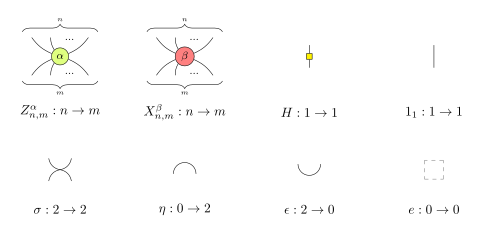
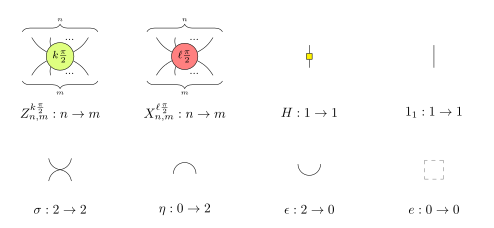
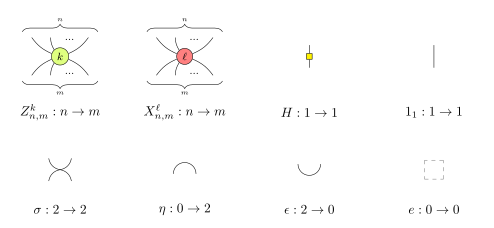
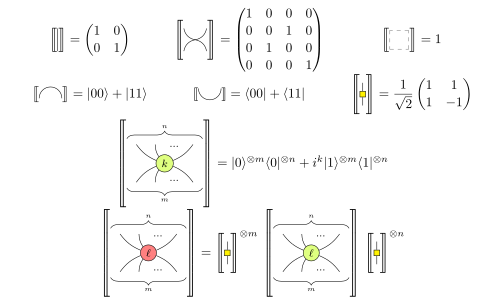
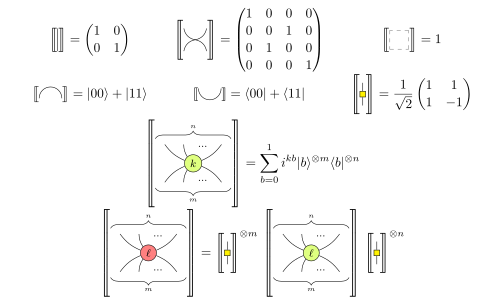
Generators

v4 generators 0
v4 generators 1
v4 generators 2
\[k,\ell\in\mathbb Z\]

Standard Interpretation

\[\llbracket\,\cdot\,\rrbracket:\mathbf{ZX}\longrightarrow\mathbf{Qubit}\]
\[\llbracket D_2\circ D_1\rrbracket=\llbracket D_2\rrbracket\circ\llbracket D_1\rrbracket\]
\[\llbracket D_2\otimes D_1\rrbracket=\llbracket D_2\rrbracket\otimes\llbracket D_1\rrbracket\]
feedback55 standard explicit
v8 early standard semantics

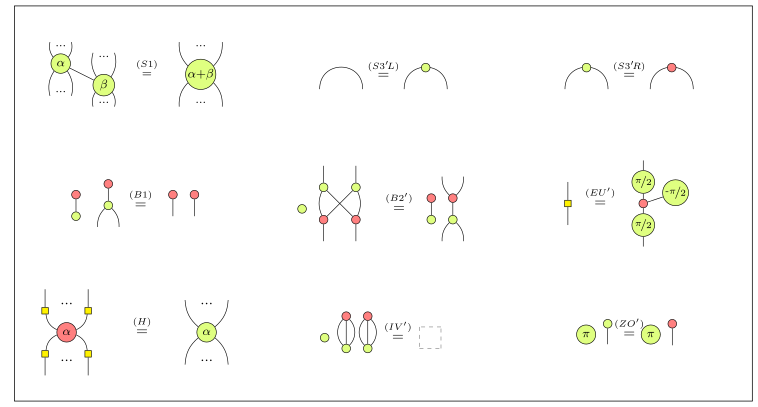
Axioms

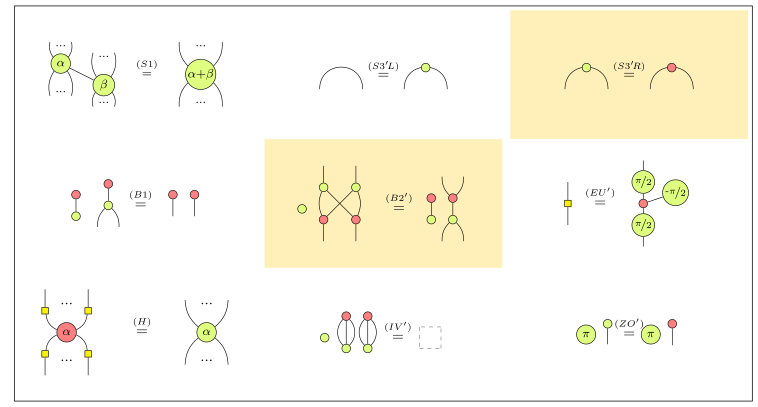
v7 early axioms 0
v7 early axioms 1
v7 early axioms 2
v7 early axioms 3

+ only connectivity matters

Only connectivity matters

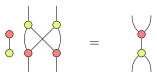
Only connectivity matters The same ZX diagram moves elastically through the three arrangements of equation 3.23. Seven spiders retain their phases and connections. Three inputs and two outputs stay in order. The red minus pi over two spider remains isolated. The animation loops.

Only connectivity matters

Definition. Two ZX diagrams are identified when their coloured, phase-labelled undirected multigraphs are isomorphic, preserving the ordered inputs and outputs.

\[G_D=(V_D,E_D,\ell_D;\mathbf i_D,\mathbf o_D,c_D).\]

\(E_D\) is a multiset of unordered pairs; \(c_D\) counts closed wire circles.

\[f:V_D\xrightarrow{\sim}V_{D\prime},\qquad f_*E_D=E_{D\prime},\quad \ell_{D\prime}(f(v))=\ell_D(v)\quad(v\in V_D),\]\[f(\mathbf i_D)=\mathbf i_{D\prime},\qquad f(\mathbf o_D)=\mathbf o_{D\prime},\qquad c_D=c_{D\prime}.\]

To check that an interpretation respects connectivity:

  • check snake equations and symmetric compact closure
  • both spiders are invariant under input/output permutations
  • Can bend inputs to outputs and vice versa for spiders and hadamard

Backens–Perdrix–Wang (2020), Definitions 2.2–2.3

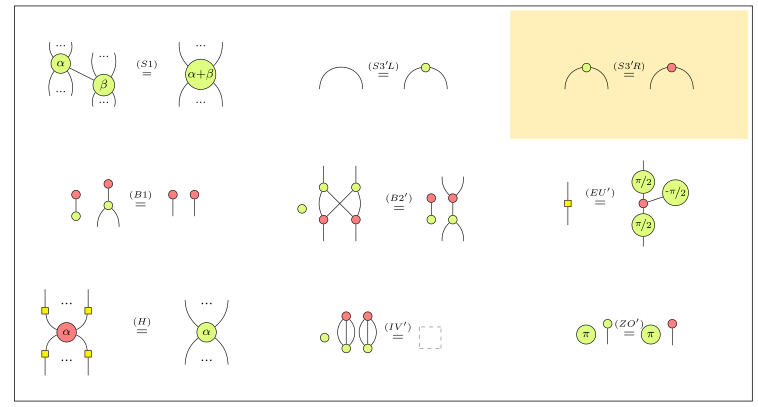
Red identity

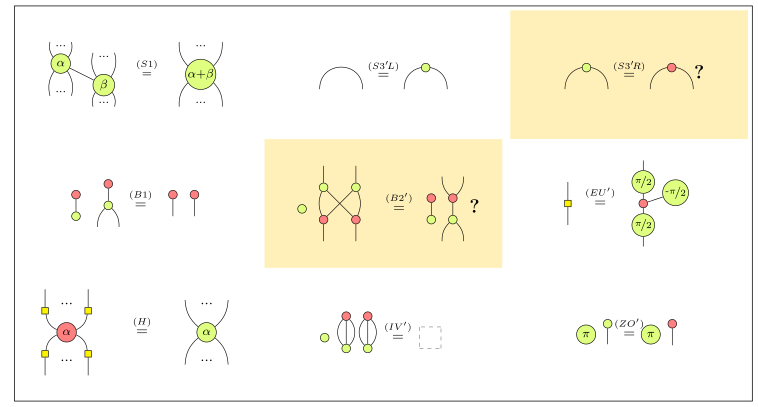
Theorem. The \((\mathrm{S3}'\mathrm{R})\) rule is necessary:

\[\mathbf{ZX}_{\boldsymbol{\mathsf{simp}}}\setminus\{(\mathrm{S3}'\mathrm{R})\}\nvdash(\mathrm{S3}'\mathrm{R}).\]

Consider:

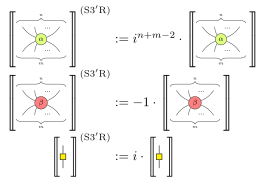
v7 counter red assignments

(Structural maps are unchanged.)

Lemma. For any ZX diagram \(D\),

\[\llbracket D\rrbracket^{(\mathrm{S3}'\mathrm{R})}=c(D)\cdot\llbracket D\rrbracket,\]
\[c(D)=(i)^{\sum_{v\in Z(D)}(\deg(v)-2)}\cdot(-1)^{|X(D)|}\cdot(i)^{|H(D)|}.\]

Red identity

\[c(D)=(i)^{\sum_{v\in Z(D)}(\deg(v)-2)}\cdot(-1)^{|X(D)|}\cdot(i)^{|H(D)|}\]
RuleScalar (both sides)
\((\mathrm{S1})\)\(i^{p+q+r+s-2}\)
\((\mathrm{S3}'\mathrm L)\)\(1\)
\((\mathrm{B1})\)\(1\)
\((\mathrm{B2}')\)\(1\)
\((\mathrm{EU}')\)\(i\)
\((\mathrm H)\)\(-1\cdot i^{n+m}\)
\((\mathrm{IV}')\)\(1\)
\((\mathrm{ZO}')\)\(\text{zero}\)

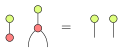
But…

v6 counter red failure

Red identity

So,

Theorem. The \((\mathrm{S3}'\mathrm{R})\) rule is necessary:

\[\mathbf{ZX}_{\boldsymbol{\mathsf{simp}}}\setminus\{(\mathrm{S3}'\mathrm{R})\}\nvdash(\mathrm{S3}'\mathrm{R}).\]

Bialgebra

Definition. Two †SCFAs on \(\mathbb C^d\) are strongly complementary when they form a scaled bialgebra:

Definition. A coherent pair of †SCFAs on \(\mathbb C^d\) is strongly complementary iff the bialgebra law holds:

Theorem. Complementary observables on \(\mathbb C^d\) admit coherent associated †SCFAs. They are strongly complementary iff:
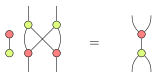
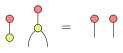
v5 counter bialgebra law
v5 counter coherence green
v5 counter coherence red
v5 counter coherence scalar

(slightly adapted) Coecke–Duncan–Kissinger–Wang (2012)
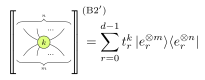
Changing the interpretation

\(\mathbf{Qubit}\)
• Objects:
\((\mathbb C^2)^{\otimes n}\)vector spacesover\(\mathbb C\)field
• Morphisms:
linear maps \(T:(\mathbb C^2)^{\otimes n}\longrightarrow(\mathbb C^2)^{\otimes m}\)
• Composition:
\(\circ\): matrix multiplication
\(\otimes\): Kronecker product

Changing the interpretation

\(\mathbf{Mat}_{\mathbb C^2}\)
• Objects:
\((\mathbb C^2)^{\otimes n}\)vector spacesover\(\mathbb C\)field
• Morphisms:
linear maps \(T:(\mathbb C^2)^{\otimes n}\longrightarrow(\mathbb C^2)^{\otimes m}\)
• Composition:
\(\circ\): matrix multiplication
\(\otimes\): Kronecker product

Changing the interpretation

\(\mathbf{Mat}_{\mathbb C^d}\)
• Objects:
\((\mathbb C^d)^{\otimes n}\)vector spacesover\(\mathbb C\)field
• Morphisms:
linear maps \(T:(\mathbb C^d)^{\otimes n}\longrightarrow(\mathbb C^d)^{\otimes m}\)
• Composition:
\(\circ\): matrix multiplication
\(\otimes\): Kronecker product

Changing the interpretation

\(\mathbf{Mat}_{R^d}\)
• Objects:
\((R^d)^{\otimes n}\)modulesover\(R\)ring
• Morphisms:
linear maps \(T:(R^d)^{\otimes n}\longrightarrow(R^d)^{\otimes m}\)
• Composition:
\(\circ\): matrix multiplication
\(\otimes\): Kronecker product
The usual structural maps
Identity:
\(I(e_r)=e_r\)
Braid:
\(\sigma(e_r\otimes e_s)=e_s\otimes e_r\)
Cup:
\(\eta(1)=\sum_r e_r\otimes e_r\)
Cap:
\(\epsilon(e_r\otimes e_s)=\delta_{rs}\)
Unit:
\(1_R\)

Generalized spiders

v8 foundation top 0
v8 foundation top 1
v8 foundation fusion lhsv8 foundation fusion rhs
v7 foundation brace
\[\Longrightarrow\]
\[t_r^k t_r^\ell=t_r^{k+\ell}\]
\[t_rt_r^{-1}=1_R\]
\[t_r\in R^\times\]

\(\therefore\) Our phase carriers
are units in \(R\).

The green classical structure

v6 foundation classical row

Lemma. These maps form a commutative special dagger Frobenius algebra in \(\mathbf{Mat}_{R^d}\).

Proof. By computation.

Hadamard

Let our Hadamard be any matrix \(H\in M_d(R)\), and
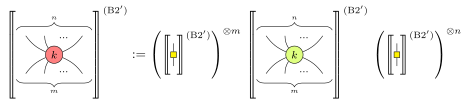
v8 foundation red definition

If we want to satisfy…

Only connectivity matters

Color change
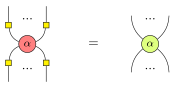
feedback55 h rule unlabelled

Red identity

v11 foundation red cup rule
\[\Longrightarrow\qquad H^T=H\quad\&\quad H^2=I\]

Choosing \(R\)

Let’s try a finite field!

\[\mathbb F_p,\qquad p\text{ prime}\]

• Spider fusion on the phase gate:

\[\operatorname{diag}(1,\iota)^2=\operatorname{diag}(1,-1)\quad\Longrightarrow\quad\iota^2=-1\]

• Hadamard normalization and \(H^2=I\):

\(\Longrightarrow\) need \(\tfrac12\), so \(2\) must be invertible.

\[\mathbb F_2\]

\(2=0\)

\[\mathbb F_3\]

no square root of \(-1\)

\[\mathbb F_5\]
\[2^{-1}=3,\quad3^2=-1\]

Choosing the dimension

By computation, Copy gives:

v11 stab closed copy
feedback55 rank scalar evaluated
\(\mathbb F_5=\{\)\(0,\)\(1,\)\(2,\)\(3,\)\(4\)\(\}\)
\[4=2^2\]

The smallest possible dimension \(d>1\) is \(4\).

Completing the interpretation

So, let’s try \((\mathbb F_5)^4\)!

Solve for Hadamard & phase tuple…

\[H=\frac12H_0,\qquad H_0=\begin{pmatrix}1&1\\1&-1\end{pmatrix}^{\otimes2}\]
\[t=t_0=(1,3,3,4)\]

All of our non-target rules are sound!

But…
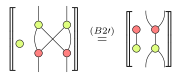
v10 stab base equation

This is a sound interpretation!

Dual numbers

Adjoin an infinitesimal to our field.

\[\mathbb F_5\]
\[R=\mathbb F_5[\varepsilon]/(\varepsilon^2)=\{a+\varepsilon b:a,b\in\mathbb F_5\}\]

The ring of dual numbers, with

\[\varepsilon\ne0,\qquad\varepsilon^2=0\]

Multiplication keeps only the constant and first-order terms:

\[(a+\varepsilon b)(c+\varepsilon d)=ac+\varepsilon(ad+bc)\]

Dual numbers linearize our equations!

Linearizing the constraints

In \(R=\mathbb F_5[\varepsilon]/(\varepsilon^2)\), write

\[H=\tfrac12(H_0+\varepsilon H_1),\qquad t=t_0+\varepsilon p\]

where \(H_0\) and \(t_0\) are as before.

Note that

\[H^2=I+\tfrac{\varepsilon}{4}(H_0H_1+H_1H_0)\]

So, \(H^T=H\) and \(H^2=I\) give

\[H_1^T=H_1,\qquad H_0H_1+H_1H_0=0\]

Only \(H_1\) and \(p\) remain to determine.

Remaining derivation

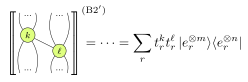
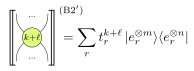
• Copy \(\Rightarrow\) Hadamard

v10 stab copy equation
\[\Longrightarrow\]
\[H_1=\lambda\begin{pmatrix}0&0&0&0\\0&-1&0&1\\0&0&1&-1\\0&1&-1&0\end{pmatrix},\quad\lambda\in\mathbb F_5\]

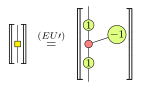
• Euler \(\Rightarrow\) phases

v10 stab euler equation
\[\Longrightarrow\]
\[p=\lambda(0,2,3,0),\qquad\lambda\in\mathbb F_5\]

• \(\neg\)Bialgebra \(\Rightarrow\lambda\)
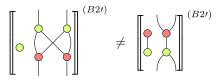
v10 stab failure equation
\[\Longrightarrow\]
\[\lambda\ne0\qquad\text{take }\lambda=1\]

The stabilizer alternate interpretation

\[R=\mathbb F_5[\varepsilon]/(\varepsilon^2),\qquad V=R^4\]
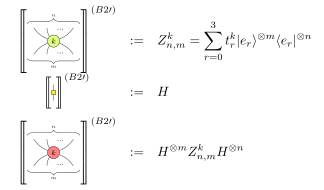
\[\llbracket\,\cdot\,\rrbracket^{(B2^\prime)}:\mathbf{ZX}\longrightarrow\mathbf{Mat}_{R^4}\]
\[\llbracket D_2\circ D_1\rrbracket^{(B2^\prime)}=\llbracket D_2\rrbracket^{(B2^\prime)}\circ\llbracket D_1\rrbracket^{(B2^\prime)}\]
\[\llbracket D_2\otimes D_1\rrbracket^{(B2^\prime)}=\llbracket D_2\rrbracket^{(B2^\prime)}\otimes\llbracket D_1\rrbracket^{(B2^\prime)}\]
v10 stab interpretation generators
\[H=\frac12(H_0+\varepsilon H_1)\]
\[H_0=\begin{pmatrix}1&1\\1&-1\end{pmatrix}^{\otimes2}\]
\[H_1=\begin{pmatrix}0&0&0&0\\0&-1&0&1\\0&0&1&-1\\0&1&-1&0\end{pmatrix}\]
\[t=(1,3+2\varepsilon,3+3\varepsilon,4)\]

and usual structural maps

Bialgebra

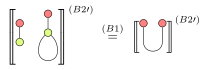
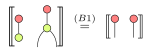
Theorem. The bialgebra \((B2^\prime)\) rule is necessary.

Proof. Consider \(\llbracket-\rrbracket^{(B2^\prime)}\).

The interpretation respects connectivity, and all the non-target rules.

Bialgebra

But…

v10 stab failure equation
\[\therefore\quad\mathbf{ZX}_{\mathsf{simp}}\setminus\{(B2^\prime)\}\;\nvdash\;(B2^\prime)\]

\(\blacksquare\)

Bialgebra

Explicitly,

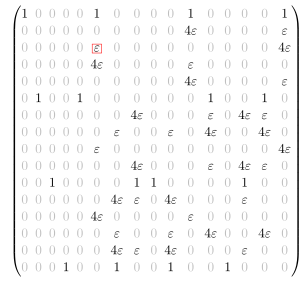
v11 witness matrix lhs
\[\ne\]
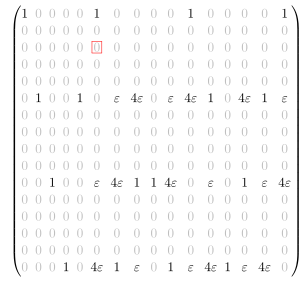
v11 witness matrix rhs

Universal ZX-calculus

2017
Completeness— Ng & Wang

“A universal completion of the ZX-calculus”

• Arbitrary real phases

2018
Completeness— Hadzihasanovic, Ng & Wang

“Two complete axiomatisations of pure-state qubit quantum computing”

• Complete ZX and ZW calculi

2018
Completeness— Jeandel, Perdrix & Vilmart

“Diagrammatic Reasoning beyond Clifford+T Quantum Mechanics”

• Complete pure-qubit ZX-calculus

2019
Near-minimality— Vilmart

“A Near-Minimal Axiomatisation of ZX-Calculus for Pure Qubit Quantum Mechanics”

• 9 rules!

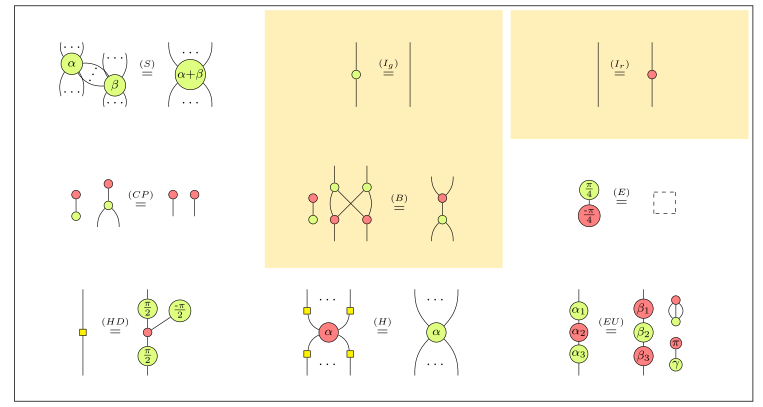
• Individual necessity of \((I_g),\ (I_r),\ (B)\) left open.

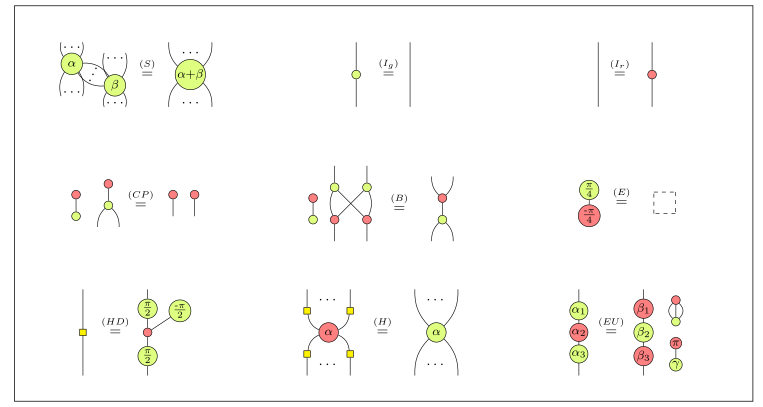
Vilmart’s near-minimal rule set

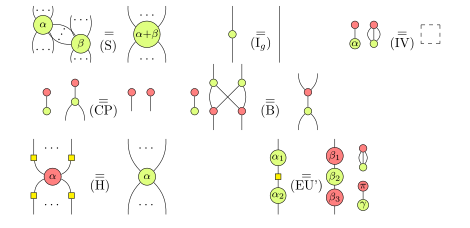
Vilmart’s nine universal ZX rules
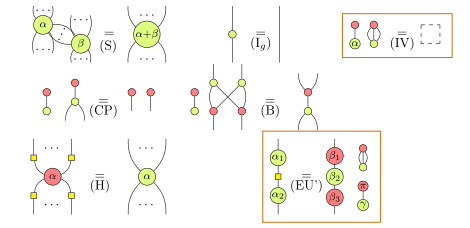
The same rules, with B, I_g and I_r highlighted

+ only connectivity matters

R. Vilmart, 2019 — (EU) uses the Euler parameters defined there

Continuous phases

Stabilizer

\[\alpha\in\tfrac\pi2\mathbb Z\]
\[\mathbb F_5[\varepsilon]/(\varepsilon^2)\]
\[d=2^2=4\]
→

Pure qubit

\[\alpha\in\mathbb R\]
\[\mathbb C[\varepsilon]/(\varepsilon^2)\]
\[d=2^3=8\]

Phase characters

For each basis index \(r\), spider fusion gives:

\[t_r(\alpha+\beta)=t_r(\alpha)t_r(\beta)\]

These are group homomorphisms!

\[t_r:(\mathbb R,+)\longrightarrow R^\times\]
\[t_r:(\mathbb R/2\pi\mathbb Z,+)\longrightarrow R^\times\]

Canonically, take:

\[t_r(\alpha)=e^{ik_r\alpha},\]
\[k_r\in\mathbb R\]
\[k_r\in\mathbb Z\]

Choosing \(R\)

If we try \(R=\mathbb F_p[\varepsilon]/(\varepsilon^2)\), every phase homomorphism is trivial:

\[t_r(\alpha)=1\]

So, the natural choice is

\[R=\mathbb C[\varepsilon]/(\varepsilon^2)\]
\[\boxed{t_r(\alpha)=e^{ik_r\alpha},\qquad k_r\in\mathbb Z}\]

(These phase characters have no \(\varepsilon\)-component!)

Rewriting the stabilizer interpretationUniversal Interpretation

Over \(\mathbb F_5[\varepsilon]/(\varepsilon^2)\), our Hadamard is

\[H=(I-\varepsilon N)\,\frac12\begin{pmatrix}1&1\\1&-1\end{pmatrix}^{\otimes2}\,(I+\varepsilon N)\]

where \(N\) is the skew matrix acting cyclically on \(|01\rangle,\ |10\rangle,\ |11\rangle\) and zero elsewhere \((N|00\rangle=0)\).

\[N=\begin{pmatrix}0&0&0&0\\0&0&-1&1\\0&1&0&-1\\0&-1&1&0\end{pmatrix}\]

If we try to generalize this to the universal fragment, it fails the Euler law, so we move up to three copies...

Over \(\mathbb C[\varepsilon]/(\varepsilon^2)\), our Hadamard is

\[H=(I-\varepsilon N)\,\frac1{2\sqrt2}\begin{pmatrix}1&1\\1&-1\end{pmatrix}^{\otimes3}\,(I+\varepsilon N)\]

where \(N\) is the skew matrix acting cyclically on \(|100\rangle,\ |010\rangle,\ |001\rangle\) and zero on the other five basis vectors.

\[N=\begin{pmatrix}0&0&0&0&0&0&0&0\\0&0&1&0&-1&0&0&0\\0&-1&0&0&1&0&0&0\\0&0&0&0&0&0&0&0\\0&1&-1&0&0&0&0&0\\0&0&0&0&0&0&0&0\\0&0&0&0&0&0&0&0\\0&0&0&0&0&0&0&0\end{pmatrix}\]

Rewriting the stabilizer phases

Our stabilizer phase tuple was

\[t_s=(1,3+2\varepsilon,3+3\varepsilon,4)\]
\[\boxed{t_s=(1,3)^{\otimes2}+\varepsilon(0,2,3,0)}\]

Extending the phases

In stabilizer...

In universal...

\(t(\alpha)=\)\((1,\)\(3\)\(i\)\(e^{i\alpha}\)\()\)\(\otimes2\)\(\otimes3\)\(+\,\varepsilon(0,2,3,0)\)

So...

\[\boxed{t_x(\alpha)=e^{i|x|\alpha},\qquad x\in\{0,1\}^3}\]

\(|x|\) is the number of ones in the bit string \(x\).

\(|x|\) is the Hamming weight of \(x\).

Note that...

\[t_{100}(\alpha)=t_{010}(\alpha)=t_{001}(\alpha)=e^{i\alpha}\]

These are precisely the three basis states mixed by \(N\).

The continuous interpretation

\[\llbracket\,\cdot\,\rrbracket^{(B)}:\mathbf{ZX}\longrightarrow\mathbf{Mat}_{R^8}\]
\[\llbracket D_2\circ D_1\rrbracket^{(B)}=\llbracket D_2\rrbracket^{(B)}\circ\llbracket D_1\rrbracket^{(B)}\]
\[\llbracket D_2\otimes D_1\rrbracket^{(B)}=\llbracket D_2\rrbracket^{(B)}\otimes\llbracket D_1\rrbracket^{(B)}\]
Interpreted green generator in the stabilizer paper style
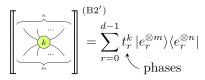
\[:=\sum_{x\in\{0,1\}^3}t_x(\alpha)|x\rangle^{\otimes m}\langle x|^{\otimes n}\]
Interpreted hadamard generator in the stabilizer paper style
\[:=H'\]
Interpreted red generator in the stabilizer paper style
\(:=\)\(\bigl(\)Interpreted hadamard generator in the stabilizer paper style\(\bigr)^{\otimes m}\)Interpreted green generator in the stabilizer paper style\(\bigl(\)Interpreted hadamard generator in the stabilizer paper style\(\bigr)^{\otimes n}\)
\[t_x(\alpha)=e^{i|x|\alpha}\]
\[x\in\{0,1\}^3,\qquad\alpha\in\mathbb R\]
\[H'=(I-\varepsilon N)\,h^{\otimes3}\,(I+\varepsilon N)\]
\[h=\frac1{\sqrt2}\begin{pmatrix}1&1\\1&-1\end{pmatrix}\]

and usual structural maps

\[\bigl(R=\mathbb C[\varepsilon]/(\varepsilon^2),\qquad V=R^{\{0,1\}^3}\bigr)\]

Bialgebra is necessary

Theorem. The \((B)\) rule is necessary:

\[\mathrm{ZX}_{\mathrm{opt}}\setminus\{(B)\}\;\nvdash\;(B)\]

Proof. The interpretation preserves connectivity.

Computing the matrices, every non-target rule is sound.
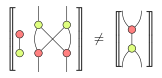
v6 late bialgebra failure

One coefficient is \(-\frac{\sqrt2}{4}\varepsilon\) on the left and \(0\) on the right.

Green identity is necessary

\[\llbracket\,\cdot\,\rrbracket^{(I_g)}:\mathbf{ZX}\longrightarrow\mathbf{Mat}_{\mathbb B^2}\]
\[\llbracket D_2\circ D_1\rrbracket^{(I_g)}=\llbracket D_2\rrbracket^{(I_g)}\circ\llbracket D_1\rrbracket^{(I_g)}\]
\[\llbracket D_2\otimes D_1\rrbracket^{(I_g)}=\llbracket D_2\rrbracket^{(I_g)}\otimes\llbracket D_1\rrbracket^{(I_g)}\]
Interpreted green generator in the stabilizer paper style
\[:=P_{n,m}\]
Interpreted hadamard generator in the stabilizer paper style
\[:=P_{1,1}\]
Interpreted red generator in the stabilizer paper style
\[:=\begin{cases}C_{n,m},&\alpha=0,\ n+m=2,\\P_{n,m},&\text{otherwise.}\end{cases}\]
\[P_{n,m}=|0\rangle^{\otimes m}\langle0|^{\otimes n}\]
\[C_{n,m}=\sum_{b=0}^{1}|b\rangle^{\otimes m}\langle b|^{\otimes n}\]

and usual structural maps

\[\bigl(R=\mathbb B=(\{0,1\},\lor,\land),\qquad V=R^2\bigr)\]

Green identity is necessary

Theorem. The \((I_g)\) rule is necessary:

\[\mathrm{ZX}_{\mathrm{opt}}\setminus\{(I_g)\}\;\nvdash\;(I_g)\]

Proof. Connectivity and every non-target rule are sound, but

I_g interpretation of the green unary spider equals diag(1,0), which is unequal to the identity matrix, equal to the I_g interpretation of the wire

The red identity is derivable

Theorem. The \((I_r)\) rule is derivable:

\[\mathrm{ZX}_{\mathrm{opt}}\;\vdash\]
v6 late red theorem

Proof:

late proof alate proof blate proof c

A second minimal ruleset

v6 late second rules 0
v6 late second rules 1

What does bialgebra detect?

Our interpretations keep a value and a first-order change:

\[\llbracket D\rrbracket^{(B)}=D_0+\varepsilon D_1,\qquad \varepsilon^2=0\]

Bialgebra and Leibniz

Theorem. Let \(A\) be an algebra over a field \(k\).

A linear map \(\partial:A\to A\) satisfies the Leibniz rule if and only if the polynomial bialgebra \(k[t]\) acts on \(A\) compatibly with multiplication, with \(t\) acting as \(\partial\).

\[\Delta(t)=t\otimes1+1\otimes t\]
\[\boxed{\partial(DE)=(\partial D)E+D(\partial E)}\]

Kassel (1995), Lemma V.6.3

Derivatives in ZX

Definition. On formal finite sums of ZX diagrams with phases affine in \(\theta\), a diagrammatic derivative is a family

\[\partial_\theta:\mathbf{ZX}_{\theta}^{+}(n,m)\longrightarrow\mathbf{ZX}_{\theta}^{+}(n,m)\]

which preserves sums and satisfies both Leibniz rules:

\[\begin{aligned}\partial(D+E)&=\partial D+\partial E,\qquad \partial 0=0,\\[.45em]\partial(E\circ D)&=(\partial E)\circ D+E\circ(\partial D),\\[.45em]\partial(D\otimes E)&=(\partial D)\otimes E+D\otimes(\partial E).\end{aligned}\]

And it commutes with interpretation:

\[\boxed{\llbracket\partial_\theta D\rrbracket=\frac{\partial}{\partial\theta}\llbracket D\rrbracket}\]

Toumi, Yeung & de Felice (2021), §§2–3

Future work

• MUBs (!)

GitHub catalogue entry 266: Exactly three mutually unbiased bases in dimension six

• Clifford+T / Other calculi / ZXW

• My dream: A unified ruleset...
Thank you!